Dealing
with unwanted honey bee colonies
"I have bees!"
This a fairly common problem with which people contact me. Here I outline the issues and my recommendations for solving the problem. It is divided into parts, as follows
Dealing with bees in the wall or other cavities
Dealing with wasps or other non-honey problems
Diagnosing the problem
1) Are they honey bees?
There are a number of insects that people call bees. Some
are bees, some are wasps, but many of them are not honey bees,
the subject of this page.
a) Are they about 3/4 inch long? If much bigger or
smaller, they are not honey bees. Very large bees are usually
carpenter bees (see FAQ). Very small bees
may be any of a large number of species of mostly non-social
bees.
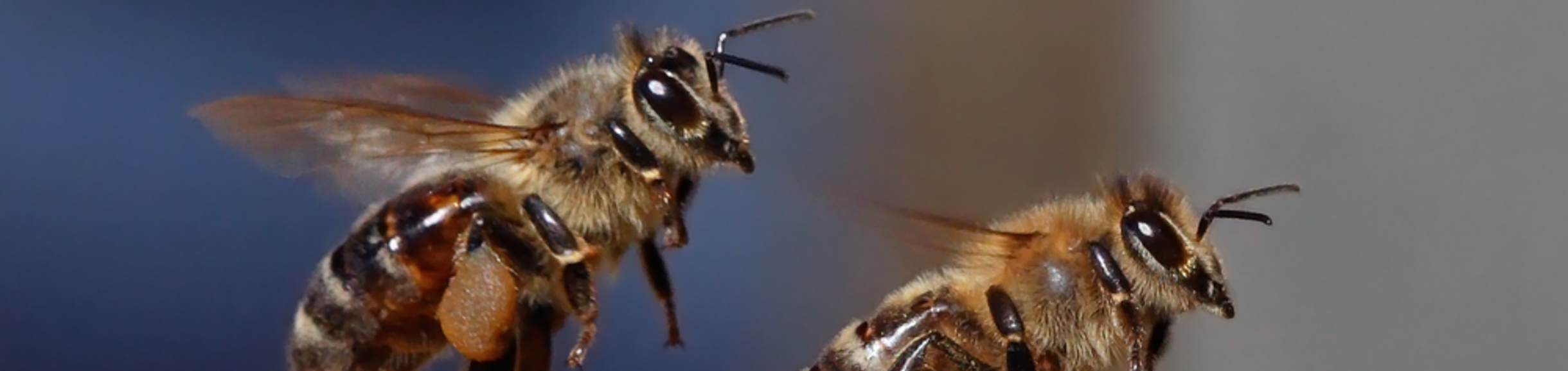
b) Are they yellowjacket wasps? Yellowjackets are about the same size as honey bees, and nest in moderate-sized colonies. They are dark black and bright yellow, with clearly defined black and yellow bands (see my wasp site). Honey bees are more brownish, and fuzzier, with less well defined bands (see graphic above)
2) Are they foraging bees, a swarm in transit, or an established colony?
a) If you just see many bees flying around flowering plants,
they are most likely just foragers visiting the flowers for nectar
and/or pollen. Foragers can sting, but generally only do so if
they are trapped or crushed. There is little than can be done
to deter foraging bees except to remove the flowers.
b) If you see a cluster of bees hanging in a tree, ranging
in size from a baseball to bigger than a football, it is probably
a swarm. Swarming bees are bees that have left their original
colony, with the old queen, and are looking for a suitable cavity
in which to form a new permanent nest. When they find one, they
will move on again en masse, usually in a few hours to
a few days after they land. The tens of thousands of flying bees
in a swarm taking off or flying is a very dramatic sight, but
usually not a great danger. Since the bees have little to defend,
swarm bees are usually fairly docile (but not always, so don't
disturb them). If you can see the edges of wax honeycombs sticking
out of the cluster, or if it remains in place for a week or more,
it is probably an established colony (see c)
c) If you see many bees coming and going from the same place (usually a hole that leads to their nest cavity, but sometimes you will just see them flying out of vegetation at one place), they are probably an established colony, living in nest made of beeswax combs that they build, usually, but not always, inside a cavity. These are the most troublesome, because they are permanent, and because the bees are more likely to defend their nest by stinging. I generally advise people to remove established colonies as soon as they can after they discover them, because the colony will continue to grow, build more comb, store more honey, and become more defensive. Unfortunately it is not terribly simple to remove an established colony inside a cavity.
Dealing with bees in the wall
Removing a bee colony from a wall is probably not something you want to do yourself. I recommend calling a professional (look under Bee Removal in the Yellow Pages, or bee removal and your city in a web search). You want to get someone who has the equipment and experience to deal with bees, and do it right. Not all pest control operators will do all that I recommend here, and I think you are asking for trouble if you just have the bees killed and nothing else, so persist in finding someone to do the complete job.
To kill or not to kill?
Bees can be removed alive from the wall by someone accustomed to working with them but it is somewhat difficult, and there is a greater risk of someone getting stung. Most pest control operators do not have the beekeeping expertise to do live removal, and besides, then they would have a colony of bees that they don't want either. On the other hand, bees are beneficial insects, and many people are reluctant to just have them killed. Some bee removal companies do live removals. Also, you may be able to find a beekeeper willing to do it. This can be an interesting sideline and service for a hobby beekeeper (commercial beekeepers are almost certainly not interested). Do not expect it will worth it to him or her just for the bees; it is a big job, the colony will probably have to be requeened after it is done, equipment built for the colony to live in, etc. If looking for a person to do a live removal, check with your county ag commissioner or extension agent, and with any local beekeeping clubs, or a web search for live bee removal and your city. It is also sometimes possible to trap bees out of a cavity, as described at this link.
Killing the bees
Many insecticides can be used to kill bees, the principal problem is getting the material to the bees inside a cavity, with multiple wax combs forming further barriers to insecticide application. Sometimes holes are drilled in the wall to inject insecticide, sometimes it can be applied through the entrance that the bees use. Note that the use of insecticide will render any honey in the colony inedible, and dangerous to other bees that might collect it in the trash, so dispose of it inside sealed trash bags.
Removing the nest
If the job ends with killing the bees, you have up to 10 pounds
of dead bees, several more pounds of developing bee larvae, wax
combs and up to 100 or so pounds of honey still inside. The rotting
bees can smell pretty bad, and, with no bees to protect them,
the combs may melt or fall. If this happens, honey will leak
out and can seep out through your wallpaper and baseboards, and
even between stories in a house. This is not good, and to avoid
it you need to remove the dead bees and the nest. This almost
always involves opening up the cavity (i.e. removing siding or
wallboard) scraping out the mess, and then repairing the wall.
As you fear, this is expensive and troublesome.
Filling the cavity
When you remove the nest, it important to keep in mind that the
smell of the old nest will remain indefinitely and make the cavity
especially attractive to future swarms of bees, so the problem
can recur. To avoid this, it is important make it so there is
no longer a cavity there for bees to move into. The easiest way
to do this is usually to fill up the space (all the space you
or the bees can get to) with fiberglass insulation. I prefer
this because it generally will not settle, as some other materials
do. Then, although scout bees may be attracted by the smell of
the old nest, when they crawl inside they will not find a cavity
of usable size, so they won't bring the rest of the swarm.
Plugging actual or potential entrances
Even if you have filled the cavity, it is a good idea to plug
up or screen over any holes or cracks that lead into the cavity.
When screening, use mesh with less than 1/4 inch openings (e.g.
1/8 hardware cloth or window screen). Remember, even if the bees
were using just one entrance, other entrances may exist; you
should search for them and close them off
Do I have to do all that?
If you know for sure that a colony has moved into a cavity within
the last 2 days, it will not have built much comb or stored much
honey. In this situation you may get away with just killing the
bees, hoping they don't smell too much, and carefully closing
off all entrances to the cavity. It is always better to do the
full job above, despite the expenditure in time and money. If
the bees have been in place more than a week you are asking for
trouble not to open the cavity to remove them. Sometimes you
will get away with it, but it can make a bad problem a lot worse
if you don't.
What if I can't open the cavity?
Sometimes the bees are nesting inside a masonry wall, or other location that can't be opened. It may be possible to trap bees out, as described at this link. Or, the best you may be able to do is kill the bees, perhaps fill the cavity with pourable insulation, block entrances very thoroughly, and cross your fingers.
Bee proofing
As the above description suggests, it is troublesome and expensive
to have bees removed from a nest in your house. It is far better
to prevent them nesting there in the first place. This is where
"bee proofing" comes in. If bees cannot find a hole
leading to a suitable cavity, they won't move in. You can get
there first, and scrutinize your property for potential bee nests.
Look for holes or cracks in the walls, soffits, etc that may
lead to cavities in the walls or attic. Caulk up the holes, or
screen them over. Also, look for other potential nesting sites,
anything with a fairly small hole leading to a cavity: examples
include upside down flower pots, old water heaters, electrical
boxes, barbeques, etc. If the cavity is removed (take it to the
dump) made wide open (turn the flower pot over) or inaccessible
(plug the holes leading to the cavity), it will no longer attract
nesting bees.
Dealing with swarms
Since swarms are relatively docile, and since they are generally completely exposed, collecting them or destroying them is easier than with established colonies. Also, if you do nothing, a swarm will usually leave with a day or so. The problem is, when they leave, it is to establish a nest in a cavity somewhere, where they are likely to be a greater problem. That "somewhere" may not be on property that is your responsibility, but it may be.
There was a time when it was fairly easy to find a beekeeper who was interested in collecting swarms when he or she got the chance, sometimes for no charge. These days, that it rare, because there are fewer beekeepers, because liability concerns have increased, and because swarms are less valuable since they be Africanized and will require a change to queen to be useful to a beekeeper. A swarm can be collected by knocking it into a box, ideally a beehive with combs, waiting for all the bees to go inside (usually until nightfall) and then taking the new hive to a permanent location. For a beekeeper this is not so hard to do, since they are accustomed to working with bees, and have a veil handy to protect them from the possibility of stings (not too likely, but it does happen). For the non-speci alist it is still possible, but more daunting. If the swarm is close to the ground it is of course easier to remove than if it requires climbing a ladder (or a tree!)
Swarms can be killed fairly easily with insecticides, or with surfactant (detergent) solutions. In California, the law requires that a surfactant be registered for this use as an insecticide, and no registered product is available to the public (Mpede insecticidal soap is used by vector control and pest control operators). Insecticides are more likely to annoy and disrupt the bees. For most people, the best course is hire a professonial pest control person to remove the swarm of bees.
Dealing with wasps and other non-honey bee problems
Some advice on these issues can be found in the FAQ) or the wasp site. More will be here when I get the time to write it.