![]() ![]() ![]() |
The
progress of Africanized Bees in the United States (1990-1995)
The range expansion of the Africanized honey bee (AHB), Apis
mellifera L. scutellata (Lepetelier) through the Americas has
been monitored like that of no other insect. This is because
these bees have had large impacts: killing people and livestock
and dramatically changing beekeeping in the countries they have
entered. There has also been exaggerated concern about the bees,
as news of their spread has inspired magazine and newspaper articles
and even motion pictures portraying juggernaut swarms of uncontrollable
deadly stinging insects invading cities and towns.
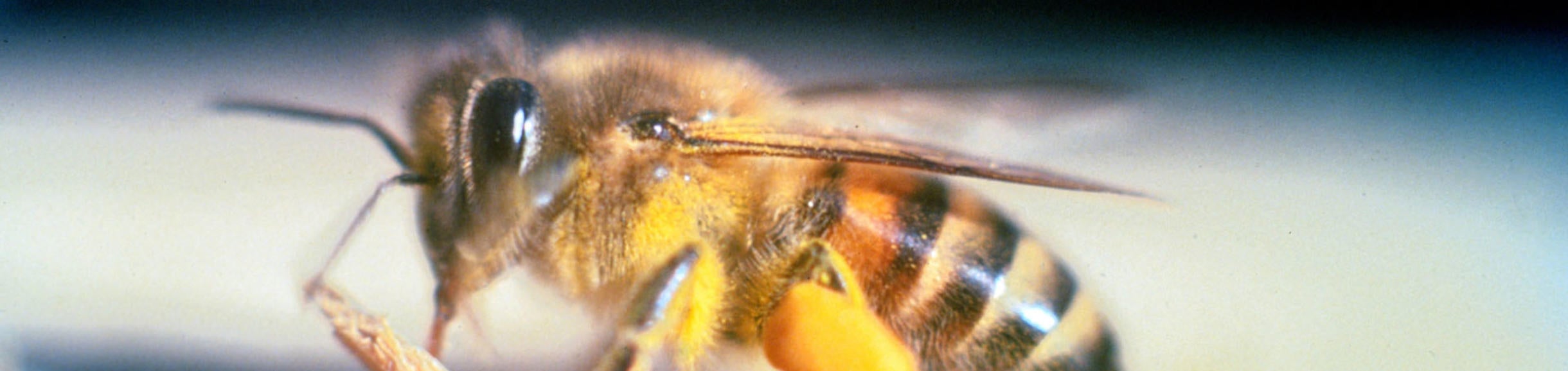
Image to right is "Africanized honey bee workers on comb".
AHB and EHB are nearly identical in appearance, and microscopic or molecular genetic analysis is needed to distinguish them.
Africanized honey bees are the result of crossbreeding between European and African strains of honey bees. In the 1950's, Brazilian geneticists reasoned that bees from tropical Africa might be better suited for the climate of tropical South America than were the European honey bees (EHB's), whose performance was disappointing. Unfortunately, this turned out to be all too true. Africanized bees were released from the breeding program before selection was completed against the stronger defensive behavior which characterizes African bees, and the AHB has taken to its new environment with vigor. These bees have spread at remarkable rates during the four decades since their release, with the leading edge advancing of up to 300 miles per year through the tropics of South and Central America. During this time, a few colonies of AHB turned up in the United States, mostly as hitchhikers on shipments of materials from South and Central America. The first time that a swarm of AHB was verified to have entered the United States on its own was in Hidalgo, Texas in October, 1990. The bee has since spread north and west through Texas and northern Mexico and currently is known to be in the 4 states bordering Mexico. Many sharply different predictions have been made as to how far AHB will eventually spread into the US. This paper reviews the progress of AHB in the US to date.
Image on left is "Closeup of a honey bee
stinger".
The sting detaches from the bee and remains in the flesh of the person stung, where it continues to pump in venom and attracts more bees to sting.
Fig. 1 (to right). Range extension of the Africanized honey bee in the United States, 1990-1995.
AHB was first detected in Texas in October 1990; by December
of that year it was discovered in the 8 southern-most counties
of the state (Figure 1). In Texas, a county is designated as
quarantined after one colony of AHB, surmised to have gotten
there by natural migration rather than by accidental transportation,
is verified within its borders. Transportation of bees out of
quarantined counties requires certification that the bees are
not Africanized. Counties in most of Texas are roughly square
and uniform in size (in contrast to counties in west Texas, New
Mexico, Arizona and California) so they are very convenient units
for tracking AHB progress.
During 1991, 13 additional counties were declared quarantined,
30 more were added in 1992 and 19 more in 1993. In 1994 and 1995,
6 and 9 additional counties, respectively, became quarantined.
However, in these last 2 years, most expansion was to the east
and west, rather than northward, as counties neighboring those
already quarantined were affected.
The first US death attributable to AHB was in Texas on 15 Aug.
1993 when an 82 year old man attempted to burn a colony out of
a house and was stung 40 times. The second fatality occurred
on 11 June 1994. An AHB colony was disturbed by a lawn mower,
and as the operator ran to escape, he passed by a 98 year old
man who was stung about 50 times and died 2 days later. These
two deaths are unusual because death due to the venom itself
(rather than allergic response or heart attack precipitated by
the attack) for adults in good health would usually require more
than 300 stings (some people have survived more than 1000 stings).
They highlight the fact that elderly people and children are
most at risk from bee attacks.
AHB entered New Mexico in October 1993 in its southwestern-most county (Hidalgo), and most likely entered from Mexico. Since that time, with the exception of Otero Co., AHB has been found only in the southernmost part of New Mexico, in counties bordering Mexico and Texas. The northern-most AHB find in New Mexico has been near the town of Garfield, about 30 miles northwest of Las Cruces. In New Mexico, there are relatively few personnel involved in surveying for AHB, and information comes mostly from the more populated areas. AHB colonies may be present in sparsely populated areas as well, and have just not been detected. Differences in survey efficiency, rather then AHB abundance probably account for the abrupt narrowing of the reported range between Arizona and New Mexico.
AHB were first discovered in Arizona when a colony, established in the roof of Tucson house, stung a small dog to death on 6 June 1993. Experienced beekeepers and federal and state scientists who examined the remains of the colony suggested the colony was between 4 and 8 months old, placing its arrival into the state possibly as early as October, 1992. On 9 Oct 1993 in Peoria (west of Phoenix), another colony was discovered when 3 dogs were fatally stung and several people received large numbers of stings. By the end of 1993, the Arizona Department of Agriculture (ADA), had recognized 57 AHB colonies from central and southern Arizona (34 feral colonies mostly from in and around homes, 22 swarms in ADA traps, and 1 beekeeper's hive). Ten of the AHB colonies detected were involved in stinging incidents, none leading to human fatalities. In 1994, there were 27 additional AHB detections, and 11 additional stinging incidents, but the bees' range had extended rather little, except northward along the Colorado River to near the small town of Poston. On 30 June 1995, when ADA's AHB program ended due to lack of funding, 95 AHB colonies had been detected, 28 involving stinging incidents. The first human fatality from AHB in Arizona occurred 6 Oct 1995 east of Phoenix when an 88 year old woman was stung over 1000 times . The second fatality, a 66 year old man stung approximately 130 times, occurred only 12 days later, also near Phoenix. The ADA no longer traces the establishment of AHB, though the Tucson USDA bee laboratory and Arizona State University are continuing work on AHB in Arizona. Stinging incidents continue to occur, sometimes resulting in animal deaths, but there have been no further human fatalities reported.
Fig. 2 (to right). Verified Africanized honey bee finds in California. The numbers refer to chronological order in which bee colonies were found in 1994 (square) and 1995 (circles). Colony #14 was California's only AHB stinging event and was non-fatal.
Once the AHB reached the western border of Arizona in 1993, it seemed likely it would soon appear across the Colorado River in California. However, it was not until 27 Oct. 1994 that the first AHB swarm was collected and identified in California, in a prison about 20 miles west of Blythe near the Arizona border (Figure 2). The second was found on 17 March 1995, south of El Centro. For the remainder of 1995, only 12 other verified colonies were found in the state: 2 more in Blythe, 7 centered around El Centro, 1 in Winterhaven, 1 in Calipatria and 1 in North Shore, all in the southeastern portion of California. In 1996 (to August) there have been additional finds in areas already mentioned, but no expansion of the range or additional stinging incidents.
After 5 years in the United States, AHB have made only limited
inroads, and they seem to have dramatically slowed their northern
expansion. Exactly why this has occurred is unknown. There are
several possible explanations: competition and genetic dilution
from European bees in the US, encountering their northern biotic
limits, parasitism by Varroa and/or tracheal mites, and local
geographic factors such as deserts and mountains, and possibly
limited nesting opportunities. We discuss the possible influence
of some of these factors below.
In western Texas, New Mexico, Arizona, and California, it may
be that regions of higher elevation and desert regions with little
forage have slowed or stopped expansion of the AHB. However,
this seems an inadequate explanation of why the bees have not
spread further into the eastern and northern parts of Texas,
which have no apparent geographic barriers. In California, AHB
has been restricted to the southeastern portion of the state
and hasn't made very strong incursions despite having a fairly
wet winter in 1995 with profuse spring blooms in the desert to
aid its migration.
The US is not the first region where AHB have encountered large
populations of European honey bees. Mexico had a very large beekeeping
industry that seemed to pose little obstacle to the spread of
AHB. However, it may be that in the more temperate climate of
the US, EHB have a stronger competitive influence on AHB. The
progress of AHB in the United States seems to be slowing at about
34° N latitude, which mirrors the experience of the southern
hemisphere. This similarity may help to predict the ultimate
range of the AHB.
Image to right is "An exposed nest".
Africanized bees build in exposed locations more frequently than do European bees.
AHB were introduced into Brazil at 22° S latitude, and
spread both north and south. They reached their southern limits
of expansion first, at approximately 34° S latitude in Argentina.
South of this, one finds hybrid bees intermediate between AHB
and EHB, and then, further south, mostly EHB. During periods
of mild weather, AHB are able to temporarily expand further south,
sometimes to 40° S latitude or even further. However, this
spread is not permanent and colder winters push the front of
AHB back to around the 34° S latitude line.
Previous predictions
Several predictions of the final expansion of AHB in the United
States have been made based upon various assumptions of low temperature
limits. The most conservative of these has AHB inhabiting just
the southern extremes of the United States, approximately the
area it currently is occupying, but also including all of Florida
and the southern Gulf states. However, some studies have shown
that AHB can tolerate cold temperatures for sustained periods
of time, and these studies have led others to extrapolate that
AHB might extend as far as the mid-United States or even survive
in climates all the way into Canada, Michigan and Maine.
Although most of these predictions rely heavily upon temperature
data, there are additional factors which may play a great role
in limiting AHB. However, these effects will not be known until
AHB reaches the northern limits of its expansion. We think these
factors may include: intense competition from the EHB of the
US beekeeping industry, patterns of seasonal forage availability
in the temperate zone, more extreme seasonal photoperiod changes
than in the tropics and subtropics (which may affect the bees
annual cycle), and the effects of Varroa mites (which are apparently
more detrimental to bees in temperate than tropical regions).
The rate of expansion of AHB in the Western Hemisphere has
slowed from its torrid 300 miles per year pace through the tropics
to an almost stagnant rate in the United States. There has been
very little northern movement of AHB in the last few years and
these bees might be reaching the limits of their northern expansion
in the United States. If so, AHB may be reaching an equilibrium
situation where further northern expansions will be seasonal
rather than permanent. On the other hand, the lull in movement
may be temporary, and may speed up again when climate conditions
change (perhaps hot or cool summers, or wet winters), or when
the population breaches geographic barriers, such as the California
deserts, and reaches more favorable habitat such as coastal areas
with abundant bee forage and nesting sites. Such factors, though,
are not so easily invoked in the eastern range, where AHB have
progressed little from eastern Texas in the last few years.
Any specific predictions of the ultimate distribution of AHB
are more likely to be proved wrong than right. However, if there
is not much further northward movement of AHB, then the earliest
and most conservative predictions may prove close to correct.
Important aspects of the temperate-climate conditions in the
northern and southern hemispheres around 34° latitude might
be symmetrical and mark the limits in which tropically-derived
AHB dominates to areas where temperate-derived EHB. These conditions
could include the biotic and abiotic conditions of temperature,
photoperiod, timing of forage availability, and increased Varroa
mite infestation.
What will this mean for California Agriculture
Image to right is "Bee colony in a water meter box".
In areas with AHB, feral colonies are more common, and frequently occupy small cavities like this water meter box, which are usually not attractive to EHB.
AHB will probably increase in abundance in many agricultural
portions of the southernmost areas of California. In addition,
AHB will probably reach the coast in southern counties, and may
thrive and expand there. However, it seems that AHB infiltration
into the agricultural areas of the Central Valley will occur
more slowly than predicted, and may never be very complete, perhaps
with a seasonal ebb and flow of AHB from densely colonized areas
in southern California.
In the regions which are colonized by AHB, these bees have the
potential to disrupt beekeeping and agriculture as they are now
practiced. Beekeepers are able to maintain colonies of EHB in
colonized areas, but with increased costs. Because of public
fear of bees, and increasing liability concerns, it becomes more
difficult to find apiary sites. These factors, combined with
already marginal economic conditions for beekeeping, will probably
result in more beekeepers leaving the business, and a net loss
of beekeeper-managed colonies. This is particularly unfortunate,
since the presence of large populations of EHB maintained by
beekeepers is probably our best defense against AHB, because
of the competition for food resources they provide as well as
the genetic effect they provide by interbreeding with AHB. A
reduction in beekeeping will have direct effects on income from
honey and queen bee production. However, of much greater economic
significance is the impact on pollination of agricultural crops.
Bee colonies are rented for pollination in many California crops,
and other crops benefit from the presence of bee colonies. A
reduction in beekeeping can be expected to increase the price
of bee rental, and may in some cases result in a shortage of
available bees, so that yields of pollination-dependent crops
suffer.
The total impact of AHB on agriculture in California will depend
strongly on how much of the state is colonized by these bees,
and how effective the response of beekeepers is in adopting new
management practices. In addition, the public response to AHB
will influence agriculture. If there are effective public and
private responses to bees as urban pest problems, in terms of
removal of unwanted bees, emergency response to stinging incidents
when they occur, and education, it will minimize impact of AHB
on public acceptance of bees, and help reduce some of the negative
effects of AHB on beekeeping.
Unfortunately, no one can provide a firm answer about how much
of the state will ultimately be colonized by AHB. Nor can we
know how strong the impact of this colonization will be in terms
of stinging incidents, or its effects on the management of EHB
colonies. However, the colonization of the southern United States
by AHB has proceeded more slowly and with less impact on public
health and beekeeping than would have been anticipated by extrapolating
experience in tropical America, and provides some ground for
optimism.
Furthermore, it is apparent that the spread of AHB in the United
States is slowing down, and northward migration in particular
may be reaching an equilibrium. If so, there will still be an
effect on agriculture, both in the growing regions that the bee
inhabits as well as in migratory beekeeping and the crops which
depend on it. If conservative predictions of AHB range in the
United States turn out to be true, then much of California would
be spared from having to deal with AHB, both in practical agriculture
and in regulatory aspects. In any case, the slow spread of AHB
has allowed agencies and enterprises time to prepare more completely
in California than they have in any other region which AHB has
colonized. The impact of this preparedness on how these new arrivals
affect people and agriculture will become apparent as the Africanized
honey bee situation in California develops and stabilizes over
the next few years.
| University
of California, Riverside Department of Entomology Insect Information Africanized Bees in California UC Riverside Take-Out Bee Traps |
Content by P. Kirk Visscher Website design by Center for Visual Computing Current as of, or last modified on |